
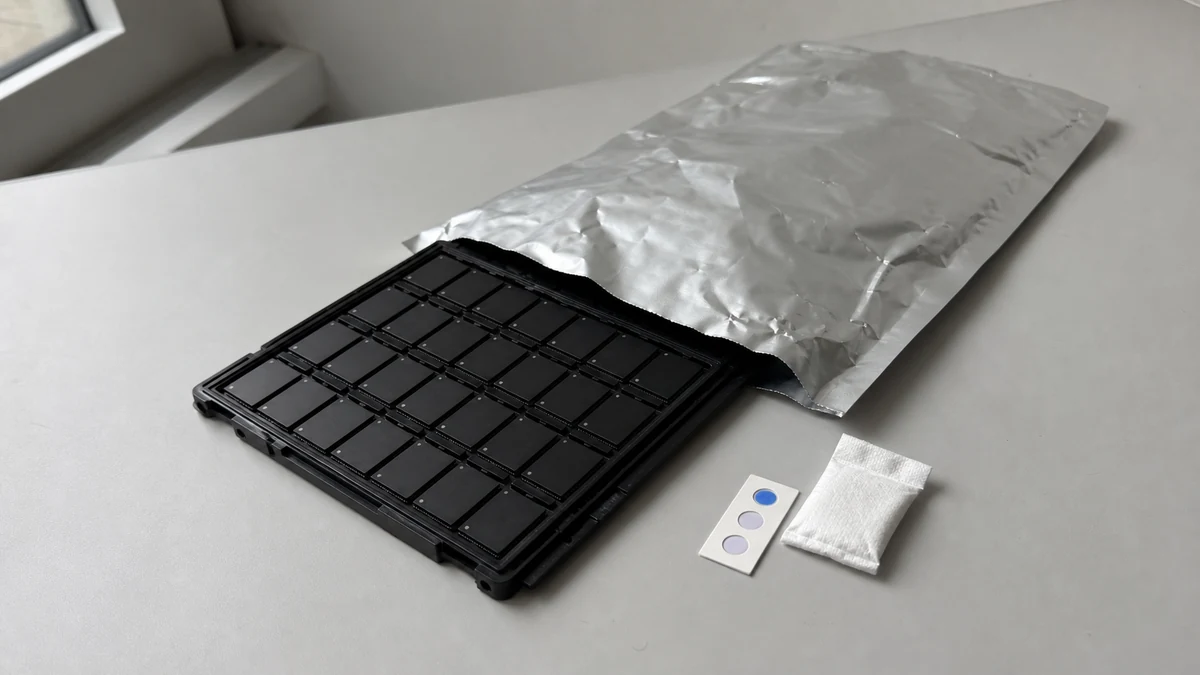
Moisture-sensitive handling of eMMC BGA packages
- Moisture status is a time- and environment-dependent material state; it cannot be inferred from package appearance after the dry pack has been opened.
- MSL, floor life, bake and reflow limits must come from the exact supplier package documentation and the contractually applicable handling standard.
- Baking is a controlled moisture-removal intervention, not evidence that oxidation, solderability loss or prior thermal damage has been eliminated.
Moisture-sensitive handling of eMMC BGA packages is a material-state control problem. Polymer encapsulants absorb moisture from the environment; rapid heating during reflow can generate internal vapor pressure and contribute to delamination, cracking or interfacial damage [1][3]. The relevant risk therefore depends on package construction, environmental exposure and the subsequent thermal process.
The purpose of a factory control plan is not to declare that all opened material is unsafe. It is to preserve enough evidence to determine whether a specific lot remained within the handling envelope defined for the exact package.
This article addresses packaged eMMC from receipt of the moisture-barrier bag through final reflow and rework. It does not define universal MSL, bake or thermal-profile values.
Normative source and scope
Four related quantities should not be conflated:
- MSL classifies package sensitivity under defined preconditioning and reflow conditions.
- Floor life is the permitted exposure under specified ambient conditions after dry-pack opening.
- Dry storage controls the rate of additional moisture uptake; whether it suspends or resets accounting depends on the applicable requirement.
- Baking is a defined intervention intended to remove absorbed moisture.
The controlling values should come from the supplier label and current package documentation for the purchased part. Micron, for example, provides package-related technical notes, including TN-00-01 on moisture sensitivity, through its eMMC resource page [4].
The applicable external standard must also be identified by revision. IPC's revision table lists J-STD-033 Revision D from May 2018 and marks the document as no longer maintained [2]. This does not invalidate an existing contractual use of Revision D, but it makes revision control and supplier-specific requirements especially important. A work instruction should not refer only to “the latest IPC rule” without naming what was approved.
Establish the initial material state at receiving
A conforming dry pack provides evidence of a known starting condition. Receiving inspection should record:
| Variable | Evidence |
|---|---|
| Identity | Manufacturer part number, package, lot, date code and quantity |
| Barrier integrity | Bag condition, seam and puncture inspection |
| Packaging time | Seal or pack date and applicable storage interval |
| Moisture control | Desiccant presence and humidity-indicator result |
| Carrier | Tray, tape or reel type and physical condition |
Add this control to the incoming-inspection plan.
A humidity indicator card is a threshold indicator for the package environment; it is not a continuous dosimeter for the component. Its result should be interpreted with bag integrity, sealing history and supplier instructions. Replacing the card and resealing a questionable bag does not reconstruct the original state.
If incoming sampling requires opening a compliant bag, the sampling procedure becomes part of the exposure history. The residual quantity needs a traceable identifier, opening time and defined return to dry storage or resealing.
Model floor life as cumulative exposure
Floor life should be maintained as a state variable associated with the material container, not with the department that currently holds it.
For each tray or child container, retain:
- parent lot and quantity;
- dry-pack opening timestamp;
- intervals outside the specified dry environment;
- dry-cabinet or reseal intervals;
- bake history and resulting status;
- remaining allowable exposure at line issue;
- final consumption, return or disposition.
Exposure can accumulate during incoming sampling, kitting, feeder setup, line stoppage, second-side assembly and rework. A system that records only pick-and-place time systematically underestimates the interval.
Remaining allowable exposure is the operational decision variable. Material with less remaining time than the expected queue plus assembly interval should not be issued without an approved disposition.
Dry storage equipment requires calibrated sensing, alarm history and an excursion rule. The nominal presence of a dry cabinet does not establish that the required environmental condition was maintained.
Baking as a controlled intervention
A bake process should be treated as an intervention with defined inputs, process uncertainty and an assigned output state. The work instruction should identify:
- applicable packages and trigger conditions;
- oven set point, tolerance and uniformity;
- duration and timing convention;
- carrier compatibility or transfer method;
- maximum cumulative thermal exposure;
- cooling, resealing and post-bake floor-life status;
- equipment, operator and lot records.
TI notes that reels, tape and other packaging materials may impose temperature limits distinct from the semiconductor package [3]. Consequently, a device may tolerate a schedule that its original carrier does not.
Baking reduces moisture only under the validated schedule. It does not demonstrate the absence of oxidation, contamination, solderability degradation, package warpage or damage from a prior thermal excursion. Those mechanisms require separate evidence.
Where exposure history is missing, the release decision should state the uncertainty rather than replacing it with an assumed opening time. Supplier disposition, solderability assessment or rejection may be necessary even if an approved bake is performed.
Reflow qualification is a separate measurement problem
Moisture compliance does not establish that the soldering process is acceptable. Reflow qualification should use temperature measurements on representative populated boards.
The measured variables normally include package-body peak temperature, time above liquidus, heating and cooling rates and location-dependent thermal variation. Qualification should cover the intended number of reflows and the approved rework profile.
Related process variables include land pattern, solder-mask design, stencil and paste deposit, placement accuracy, board support, warpage and X-ray criteria.
A successful electrical program operation confirms communication at the time of test. It does not by itself establish BGA joint integrity. Keep assembly-process evidence distinct from the eMMC provisioning record.
Decision rules under abnormal conditions
Predefine responses to common departures:
| Observation | Immediate control | Evidence needed for disposition |
|---|---|---|
| Damaged incoming bag | Hold the package | Indicator, seal date, supplier instruction and lot history |
| Floor life exceeded | Stop issue and segregate | Exposure record and approved bake/disposition rule |
| Dry-cabinet excursion | Identify all material present | Measured condition, duration and container history |
| Reflow profile outside limit | Hold boards and residual material | Actual profile, board position, inspection and package limits |
| Opening time unknown | Classify status as unverified | Reconstructed records and quality risk assessment |
| Rework required | Hold affected boards | Cumulative exposure, reflow count and approved rework profile |
The release authority should belong to quality or manufacturing engineering, not to the operator facing line downtime.
Traceability and limitations
The material record should connect the eMMC lot, dry-pack status, exposure, bake, placement line, reflow profile and resulting board serial numbers. Bidirectional traceability allows a suspect tray to be mapped to boards and a field return to be mapped back to assembly history.
Packaging, package-construction or MSL changes should enter the supplier PCN/EOL process even when the electrical specification remains unchanged.
The main limitation of floor-life accounting is model dependence: the clock is valid only for the environmental conditions and package requirements on which it is based. An accurate timestamp cannot compensate for an incorrect package classification, an unmeasured cabinet excursion or an unqualified thermal profile. Release therefore requires both exposure records and control of the underlying assumptions.
FAQ
Can one MSL and bake rule be applied to all eMMC BGA packages?
What is the correct starting point for floor-life accounting?
Does baking justify release when exposure history is unknown?
References
We publish measured usable capacity and welcome trial-batch verification — automotive-grade, direct from the source factory.