
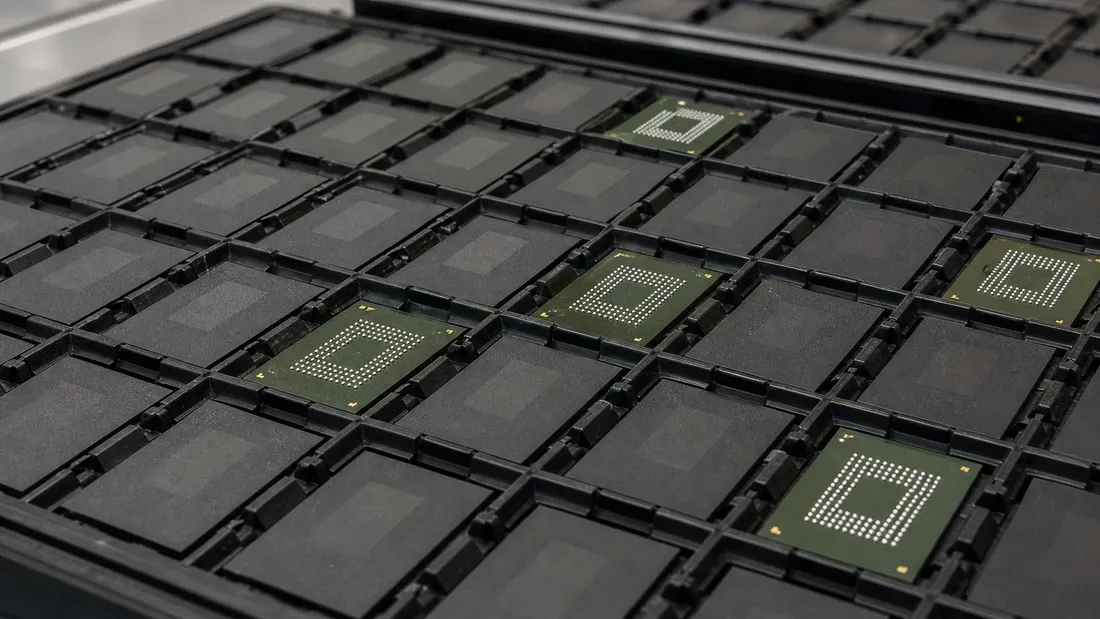
eMMC and UFS second-source qualification for OEMs
- A JEDEC-compatible package and nominal capacity do not make two managed-flash devices operationally interchangeable.
- Second-source qualification must cover identity parsing, boot and partition configuration, RPMB/security flows, sustained and tail performance, power loss and recovery.
- Run the candidate through the released board, bootloader, kernel, filesystem, provisioning station and application workload—not only a socket tester.
- Approve a controlled part-number and revision envelope, then link supplier PCN, firmware and material changes to requalification triggers.
Second sourcing is often framed as a supply-chain question: can vendor B provide the same capacity and package as vendor A? For eMMC and UFS, that framing is incomplete. Both are managed flash devices containing NAND, a controller, firmware and internal media-management policy. The host sees a standardized interface, but the system can still observe different initialization timing, feature support, latency, power behavior, health reporting and failure recovery.
The correct objective is not “find an equivalent chip.” It is “qualify a controlled substitution that preserves the product contract.”
Define equivalence at the system boundary
JEDEC develops the e.MMC and UFS standards [1]. Compliance enables interoperability, but it does not fix every internal implementation choice or application result. Write a candidate specification that separates mandatory equivalence from permitted difference.
| Layer | Mandatory questions |
|---|---|
| Commercial identity | Exact orderable part, lifecycle, capacity, package, temperature grade and change-notification terms |
| Electrical/interface | Supported specification revision, voltage rails, timing, bus/gear modes, reset and power-state behavior |
| Logical configuration | User capacity, boot areas, logical units or partitions, enhanced/reliable areas and cache features |
| Security | RPMB size and provisioning, authentication flow, secure erase/removal behavior and key ownership |
| Performance | Sustained throughput, small-I/O latency, tail latency, background-operation impact and near-full behavior |
| Reliability | Endurance claim, retention basis, health indicators, abrupt-power-loss response and recovery |
| Manufacturing | Programming time, irreversible steps, readback, traceability and station compatibility |
Do not use the incumbent's measured behavior as an undocumented specification. Decide which characteristics the product actually requires and write limits with the engineering, manufacturing and service owners.
Freeze candidate identity and documentation
For every sample, retain:
- supplier and complete ordering code;
- capacity, package drawing and ball map;
- date/lot code and sample provenance;
- device and specification revision;
- firmware or product revision exposed to the host;
- approved operating-temperature grade;
- supplier datasheet, errata and qualification statement revision;
- PCN notice period and requalification responsibility.
For eMMC, capture CID, CSD and EXT_CSD before changing configuration. Linux mmc-utils can print and parse EXT_CSD and CID, inspect write protection, configure boot behavior, enable BKOPS, work with enhanced areas and access RPMB functions [2]. For UFS, capture the device, geometry, configuration, unit, interconnect, power and health descriptors available on the platform. Linux documents UFS descriptor access and the userspace path for UFS tooling [3].
The output becomes a machine-readable allowlist. An unexpected manufacturer ID, revision or capacity should stop production rather than fall through to a generic recipe.
Qualify boot and provisioning first
Embedded-storage substitutions frequently fail before workload testing because the manufacturing recipe assumes incumbent behavior.
Test the exact released flow:
- blank-device discovery and identity allowlist;
- irreversible-configuration authorization gate;
- boot-area or logical-unit configuration;
- enhanced-area, reliable-write, cache or WriteBooster settings where used;
- bootloader, OS, recovery and data image programming;
- RPMB key programming or secure provisioning in the authorized environment;
- power cycle and configuration readback;
- unit-level record tying device identity to board serial and image hashes.
Never assume that a script safe for one eMMC density is safe for another. Some EXT_CSD operations and RPMB key actions are one-time or effectively irreversible. The eMMC production-provisioning guide provides a separate control framework for those steps.
For UFS, verify that the bootloader and kernel negotiate the intended link and power modes, enumerate the expected logical units and handle candidate descriptors without vendor-specific assumptions.
Test the released software stack
A socket tester can establish basic electrical and data access, but second-source approval belongs on the production board. Use the released or release-candidate:
- SoC and board revision;
- boot ROM assumptions and bootloader;
- storage controller and PHY settings;
- kernel and driver;
- filesystem and encryption layer;
- power-management policy;
- provisioning and field-update tools;
- application workload.
Run repeated cold boot, warm reboot, watchdog reset, suspend/resume and low-power transitions. Record enumeration time, boot time, negotiated mode, error/retry counters and failures by unit. A single successful boot can miss slow initialization tails and intermittent power-sequencing sensitivity.
Compare performance distributions, not headline speed
KIOXIA's UFS product brief illustrates the managed architecture: NAND, controller, error correction, wear leveling, logical-to-physical translation and bad-block management reside inside the package [4]. Suppliers can implement these functions differently while meeting the same interface family.
Build an application-relevant matrix:
| State | Measurements |
|---|---|
| Fresh and empty | Baseline throughput, IOPS and latency distribution |
| Preconditioned steady state | Sustained write, read interference and tail latency |
| Near-full user area | Garbage-collection impact and recovery |
| Thermal boundary | Throttling, errors and latency under the qualified range |
| Background operations | Long stalls, host timeout margin and QoS recovery |
| Endurance-conditioned sample | Data integrity, performance shift and health reporting |
Report medians and percentiles appropriate to the application, not only the best transfer rate. For logging, camera and control products, long write stalls may be more consequential than average bandwidth. The eMMC BKOPS and latency guide explains the background-operation risk in more detail.
Verify data integrity and power-loss recovery
Use controlled records containing logical address, sequence number and checksum, with the expected manifest held on an independent system. Cover sequential and random workloads, different block sizes, cache/flush behavior, partial fill, near-full state and application filesystem recovery.
During abrupt-power-loss testing, distinguish:
- writes contractually durable before interruption;
- in-flight writes whose final value may be indeterminate;
- untouched addresses that must never change;
- boot/configuration metadata and RPMB state;
- time to enumerate and return to stable I/O.
Record the voltage at the storage device, not only the bench-supply switch event. Preserve the first post-recovery state before filesystem repair or repeated reboot. A device that eventually boots may still fail the product's data-correctness or recovery-time requirement.
Treat security as a compatibility requirement
If the product uses RPMB, verified boot, rollback protection or hardware-backed secure storage, run the real security lifecycle:
- authorized key provisioning;
- authenticated read/write and counter behavior;
- reboot and update flows;
- rejected replay or invalid authentication where testable;
- factory reset and service procedure;
- failure handling without exposing keys in logs.
Do not reuse production secrets in qualification. Use an isolated test key hierarchy and prove that the manufacturing station selects the correct policy for each approved device.
Write an evidence-based approval table
| Result | Approval meaning |
|---|---|
| Package and identity match | Candidate is physically and commercially defined |
| Provisioning and boot pass | Released manufacturing and boot paths are compatible |
| Workload limits pass | Application performance envelope is supported |
| Power-loss and recovery pass | Tested durability and availability contract is met |
| Security lifecycle passes | RPMB and trusted software flows remain valid |
| Environmental and endurance evidence pass | Reliability boundary is documented |
All rows are required for production approval. A failure should identify the layer and retain raw logs, not be summarized as “vendor B incompatible.”
Control the approved substitution
Approve exact part numbers and a written revision envelope. Link them to the AVL, BOM, provisioning recipe, software release and test report. Require supplier notification for controller, NAND, firmware, package, capacity or relevant manufacturing changes, then route each notice through the flash-storage PCN/EOL process.
Suggested RFQ language:
Proposed eMMC or UFS shall be supplied under an identified orderable part number, revision and material-change boundary. Approval is conditional on OEM verification of identity, provisioning, boot, RPMB/security, workload performance, power-loss recovery and production traceability. No substitution or firmware/material change is authorized without written notification and requalification review.
For a candidate and sample plan, use the OEM flash-storage sourcing page and attach the required host, lifecycle and test conditions.
Bottom line
An eMMC or UFS second source is not approved because it fits the footprint and boots once. It is approved when a defined candidate passes the complete product path—from blank-device provisioning through field workload, power interruption, security and change control—and the evidence is tied to the exact parts the factory may buy.
FAQ
Can an OEM replace eMMC with another vendor at the same capacity?
Is a successful boot enough to approve an eMMC or UFS second source?
What should trigger requalification after approval?
References
We publish measured usable capacity and welcome trial-batch verification — automotive-grade, direct from the source factory.