
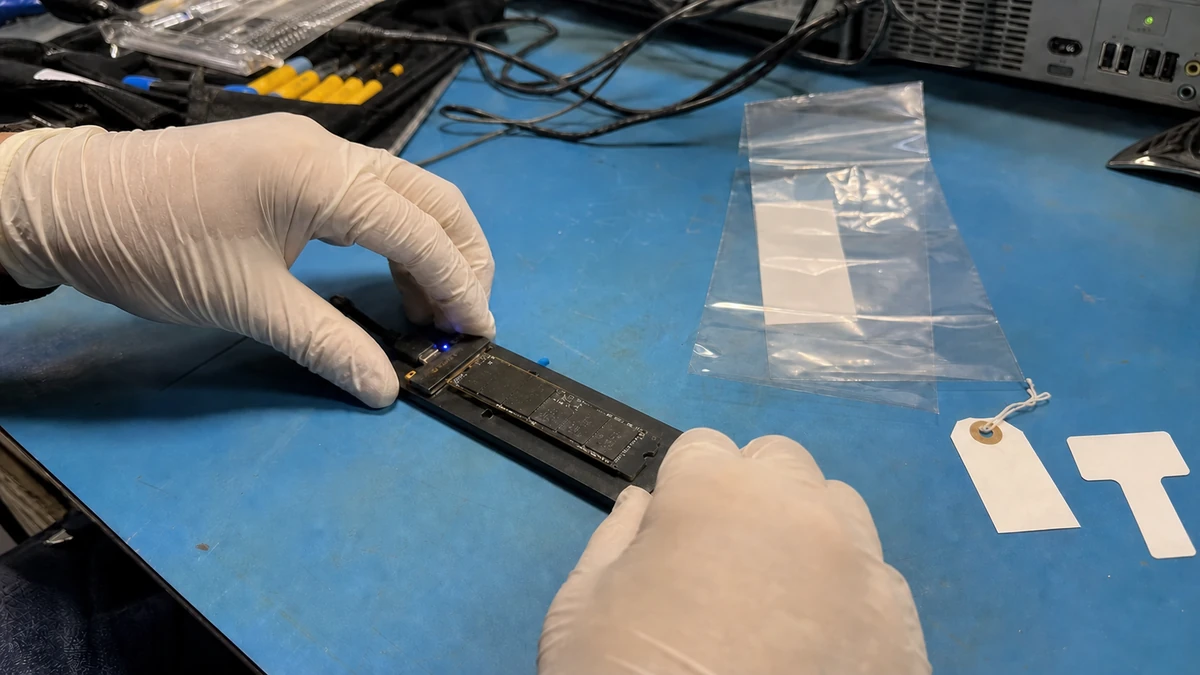
Flash storage RMA analysis and evidence preservation
- The validity of a failure analysis depends on preserving the device state before firmware changes, destructive writes, sanitization or uncontrolled reset cycles.
- A reproducible failure statement links device identity, host configuration, operating condition, observed response and the population from which the sample was drawn.
- Containment is a risk-control decision; root cause is a causal claim and requires evidence that distinguishes the proposed mechanism from plausible alternatives.
Failure analysis of a returned flash device has two related objectives: characterize the failure mode of the sample and determine what, if anything, can be inferred about the wider product population. Both depend on the quality of evidence collected before the device state is altered.
A common analytical failure occurs when troubleshooting precedes preservation. Repeated power cycles, firmware activation, filesystem repair or full-media writes may restore function, but they can also change persistent logs, media state and reproducibility. The returned unit then represents the laboratory intervention as much as the original field event.
This article describes a device-level evidence protocol for OEM supplier-quality work. It is not a data-recovery procedure and does not replace interface-specific diagnostic instructions or formal forensic requirements.
Evidence preservation as measurement control
Treat the state of the returned device as part of the measurement. Once a unit is assigned to failure analysis, establish an evidence owner and record its condition before exploratory testing.
The initial record should include photographs in the installed position, host and slot identity, visible damage or contamination, and the response observed by the operator. Read-only or non-destructive data collection should precede operations that may alter the device.
Until the capture plan permits them, defer:
- firmware download, commit or activation;
- format, sanitize and filesystem repair;
- full-device writes and destructive benchmarks;
- uncontrolled reset or power-cycle loops;
- physical opening or probing by an unapproved laboratory.
For NVMe devices, controlled management tools can retrieve controller identity, firmware revision, SMART/Health information, error records and supported telemetry [1][2]. Preserve the raw output together with the command, tool version, timestamp and completion status. A summarized health indicator removes information and cannot be reinterpreted when the hypothesis changes.
The same principle applies to SATA, eMMC, USB and memory cards, although the available registers and commands differ by interface and supplier.
Construct an operational failure statement
A statement such as “SSD not detected” identifies a symptom category but not a reproducible event. An operational statement should bind five elements:
| Element | Required description |
|---|---|
| Test object | Printed and electronic model, serial, capacity, hardware and firmware revision |
| Test system | Board, BIOS/BMC, operating system, driver, slot and adapter |
| Initial condition | Power state, workload, uptime, temperature and recent maintenance |
| Observed response | Enumeration loss, timeout, read-only transition, data mismatch or other measurable outcome |
| Population | Number observed, quantity exposed, associated lots, WIP and finished goods |
For example:
Device 7A21 failed to enumerate after a warm reboot on board revision C with BIOS 1.8. Enumeration returned after input power was removed for 30 seconds. The response occurred in 2 of 46 systems; both devices reported firmware 3.14 and originated from receiving lot L2406.
This statement defines conditions that another laboratory can reproduce and variables that can be compared.
Link the serial number to the incoming-inspection record and the qualification baseline. A revision absent from the qualification sample is an explanatory variable, not proof of cause, and should be treated accordingly.
Triangulate device, host and application evidence
No single health field provides a complete diagnosis. A zero media-error count does not exclude link instability, power interruption or controller firmware deadlock. Conversely, a high lifetime-use value may be expected for the application and unrelated to the reported event.
Interpret evidence across three layers:
- Device: identity, SMART/Health, error information, event records and telemetry.
- Host: operating-system, driver, BIOS/BMC, reset, power and PCIe link events.
- Application: workload, request timing, data-integrity checks and service-level symptoms.
NVM Express describes error reporting, logging and telemetry as diagnostic mechanisms [2]. Their evidential value depends on time correlation and on whether collection occurred before or after recovery.
Use a consistent interpretation of NVMe SMART/Health fields. Critical Warning, media/data-integrity errors and Percentage Used represent different dimensions of state and should not be collapsed into a single health score.
Reproduction requires controls
Reproduction is an experiment. Define the initial state, independent variables, stimulus, expected response and failure criterion before cycling the sample.
Record every attempt. If a response occurs in three of ten controlled cycles, the denominator and the ten starting conditions are part of the result. Reporting only the successful reproduction biases the estimate.
Include a known-good control from the same approved configuration where possible. A second control from another lot or revision can help separate sample-specific, lot-specific and system-level effects. If the returned device is unique or contains sensitive data, develop the procedure on a noncritical sample before exposing the evidence unit.
Interruption testing, including power removal during firmware activation, should be performed only when the supplier defines the expected behavior and a recovery method exists. Otherwise the experiment may create a new failure mode unrelated to the field event.
Separate population risk from causal inference
Containment and root cause answer different questions.
Containment estimates the practical risk of continued exposure and may justify holding a receiving lot, stopping a build range, screening inventory or increasing field monitoring before causality is known. The record should define the covered population, release authority and review interval.
Root cause is a causal proposition. It should explain the observed response, distinguish the proposed mechanism from credible alternatives, identify the affected configuration or process range, and survive a verification test.
ASQ's 8D framework separates interim containment, root-cause verification, corrective action and effectiveness review [4]. That separation prevents provisional labels such as “firmware issue” or “no fault found” from being treated as completed analysis.
A supplier conclusion should therefore state:
- whether the reported response was reproduced;
- the evidence that differentiates good and failed samples;
- the mechanism connecting the evidence to the response;
- the affected and unaffected revision or process range;
- the escape point in qualification or production control;
- the method used to verify corrective-action effectiveness.
Failure to reproduce is not evidence of absence. It narrows the conclusion to the conditions actually tested.
Data governance and custody
A returned flash device may contain customer data, credentials, cryptographic material or proprietary software. Analytical access must be authorized before shipment.
NIST defines chain of custody as tracking each handler, time and purpose associated with evidence [3]. An OEM RMA record should identify the device serial and seal, each transfer, tests performed and every state change. This supports technical traceability even when legal forensic procedures do not apply.
Data authorization is separate from physical custody. Specify whether the supplier may access user data, the permitted laboratory location, retention period and final destruction or return method. An NDA alone does not establish those permissions.
If sanitization is mandatory, document the resulting limitation. Alternative scopes may include remote log collection, board-level inspection without media access, or replacement without destructive analysis.
Evidence package and analytical closure
A complete RMA package should allow the supplier to begin analysis without reconstructing the incident through email. It should contain:
- the operational failure statement and business impact;
- affected population and current containment;
- sample manifest and custody record;
- raw device, host and application evidence;
- reproduction protocol and all observed outcomes;
- known-good comparison;
- prior interventions that changed device state;
- requested deliverables, dates and decision owners.
Agree before shipment whether the laboratory may open, cross-section or consume the device.
Closure should update the control system that allowed the event to escape. Depending on the verified mechanism, this may change qualification coverage, incoming data capture, production screening, firmware control or the supplier PCN/EOL process.
The principal limitation of any RMA conclusion is sampling. A mechanism demonstrated in one unit may explain that unit without defining fleet prevalence. Population claims should therefore state the supporting sample, traceability evidence and uncertainty rather than extrapolating from the returned device alone.
FAQ
Which evidence should be collected before a failed flash device is returned?
May the OEM update or sanitize the device before analysis?
Can root cause be established from one returned unit?
References
We publish measured usable capacity and welcome trial-batch verification — automotive-grade, direct from the source factory.