
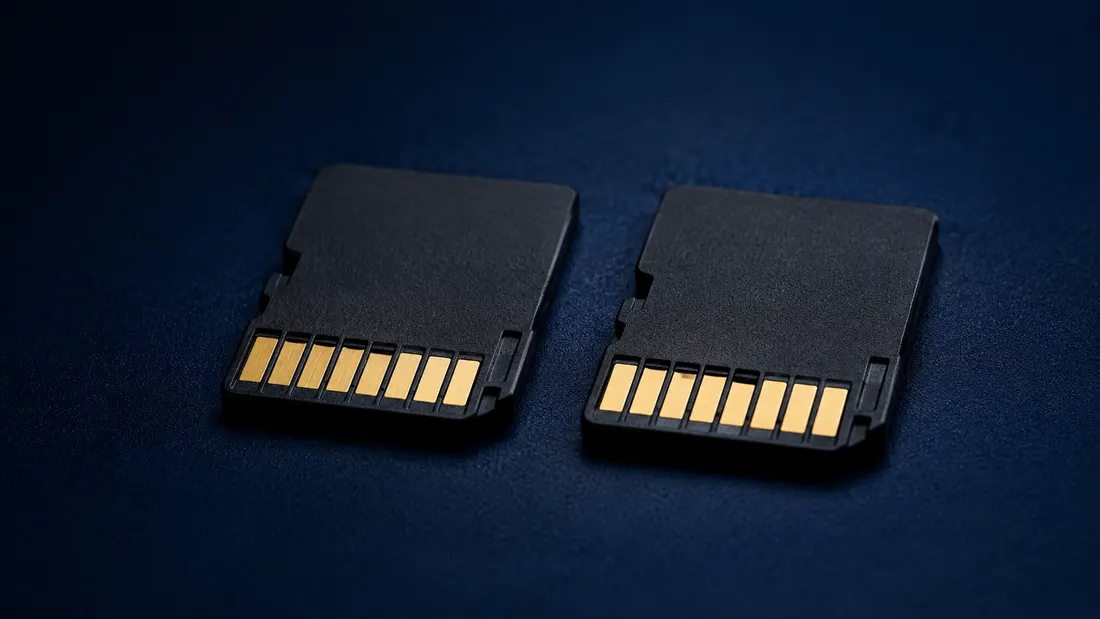
High-endurance vs consumer microSD: what the evidence can prove
- High-endurance is a product-family claim that must be supported by an exact SKU rating, warranty and test conditions; it is not a universal P/E-cycle number.
- Calculate recorder host writes from measured aggregate bitrate, but do not equate host writes with internal NAND writes unless the supplier rating defines that relationship.
- Speed class, endurance, temperature and power behavior are separate evidence fields. Passing one does not prove the others.
- The release decision belongs to an identified card in the real host through full-address, repeated-overwrite, thermal and recovery checks.
“High-endurance” and “consumer” are useful market categories, but they are not lifetime equations. A recorder workload can justify an endurance-focused product, yet a reliable comparison still requires the exact card, exact capacity, published conditions and a real-host test.
The common shortcut is to assign a generic program/erase count to a NAND label, multiply it by card capacity and publish a service-life estimate. That arithmetic omits controller behavior, spare area, firmware, NAND generation, defect management, write amplification, temperature and the supplier's own rating method. None of those fields can be recovered from the label alone.
Start with the workload that the host actually writes
For continuous recording in decimal units:
Host writes per day (GB) = aggregate bitrate (Mbit/s) × 10.8
Host writes per year (TB) = daily GB × 365 ÷ 1,000
| Aggregate bitrate | Daily host writes | Annual host writes |
|---|---|---|
| 8 Mbit/s | 86.4GB | 31.5TB |
| 15 Mbit/s | 162.0GB | 59.1TB |
| 20 Mbit/s | 216.0GB | 78.8TB |
| 32 Mbit/s | 345.6GB | 126.1TB |
These are calculated host writes. They are not NAND writes and they do not produce a lifetime without a compatible product rating. Internal metadata, block relocation and garbage collection can cause the controller to program more than the host sends. The relationship can also change with free space, file rotation, transfer size and firmware.
Resolution is not a substitute for bitrate. Two 4K cameras can use different codecs, frame rates, quality settings and stream counts. Measure a representative day/night cycle and include audio and secondary streams.
What an endurance product should document
Vendors such as Samsung, Western Digital and Kingston publish surveillance-oriented product families with rated hours, environmental ranges or application positioning [1][2][3]. The comparison must stay at exact-SKU level:
| Field | What to capture | Why it matters |
|---|---|---|
| Part number and capacity | complete orderable identifier | family ratings may differ by capacity |
| Rating type | recording hours, TBW or another workload definition | different units cannot be compared without assumptions |
| Rating conditions | bitrate, recording format, duty or vendor footnote | determines whether the buyer workload is comparable |
| Operating temperature | exact published range | enclosure temperature may exceed room ambient |
| Warranty scope | term and application exclusions | a headline life estimate is not warranty coverage |
| Product identity/control | firmware, controller/NAND scope when available | links the tested sample to repeat orders |
A manufacturer may rate a larger capacity for more recording hours. That does not establish a universal “double capacity equals double life” rule for every card. Use the family table and footnotes for the exact model.
Why raw P/E-cycle math is not a card specification
P/E cycles describe physical flash behavior, but a managed microSD card presents logical addresses through a controller. The buyer usually cannot observe raw block count, spare area, wear distribution or internal write amplification.
The simplified expression
theoretical NAND write capacity = physical flash × P/E cycles
can teach why wear exists. It cannot support a product claim unless physical flash, usable spare area, cycle definition, workload and end-of-life criterion are all known. A generic “TLC equals 1,000 cycles” assumption is particularly weak because TLC spans multiple NAND generations and operating conditions.
For procurement, prefer a supplier rating tied to the orderable SKU. If no quantitative endurance evidence is available, record that gap. Do not fill it with a value copied from another vendor or an industrial NAND article.
Speed class answers a different question
The SD Association defines Video Speed Classes such as V10 and V30 as minimum write-performance classes under specified card and host access methods [4]. V30 denotes 30MB/s within that framework. It does not describe write lifetime.
Compare the recorder's documented requirement and peak aggregate data rate with the candidate class, then run repeated recording. A stream averaging 4MB/s can still create short peaks, metadata updates and file-close operations. Host support and implementation matter alongside the arithmetic.
A high V-class does not prove high endurance. A high-endurance label does not prove that the host supports the card or that the card meets a required V-class. Keep the fields separate in the approval record.
Temperature and power are not endurance footnotes
Use the exact operating range for the proposed SKU. A parked vehicle, outdoor enclosure and indoor camera create different card temperatures. Record temperature at or near the socket during sustained recording; weather data or room ambient may not represent the device.
Abrupt power interruption adds another failure mechanism. It can affect the active video segment, filesystem metadata or recorder recovery even before the flash reaches a wear limit. Test controlled interruption at defined phases and verify that the host mounts, preserves earlier files and resumes recording. Do not infer card-level power-loss protection from a successful reboot.
A defensible comparison table
| Decision | Consumer candidate | Endurance candidate | Evidence required from both |
|---|---|---|---|
| Light, occasional writes | may be suitable | may be unnecessary | host compatibility and capacity |
| Continuous circular recording | quantitative evidence often limited | application-oriented evidence may be available | exact rating, temperature and wraparound test |
| Hot vehicle or outdoor enclosure | exact range may be insufficient | some SKUs publish wider ranges | measured device temperature versus datasheet |
| Long controlled program | configuration may change | control may still vary by supplier | written fixed/allowed fields and change terms |
The table does not declare every endurance card better than every consumer card. It shows where a surveillance-oriented product is more likely to provide relevant evidence. The final result still belongs to the proposed configuration.
Qualification checklist
- Capture recorder model, firmware, supported capacity and required speed class.
- Measure average and peak aggregate bitrate through representative scenes.
- Calculate retention and annual host writes with a declared reserve.
- Record the exact candidate part, capacity, rating conditions, temperature and warranty.
- Verify the full available address range before endurance testing.
- Record through multiple complete wraparound cycles at representative temperature.
- Test credible power interruptions and application recovery.
- Preserve identity, logs, errors and acceptance criteria.
- Define which configuration fields must match on repeat orders.
Kalstor can use this package to evaluate a candidate for a B2B RFQ. The quoted record must confirm current availability, MOQ, lead time, rating evidence and configuration scope. No inventory or service-life promise follows from the category name alone.
FAQ
How long will a consumer microSD last in a 24/7 recorder?
What does a rated-hours figure mean?
Is V30 the same as high endurance?
References
We publish measured usable capacity and welcome trial-batch verification — automotive-grade, direct from the source factory.