
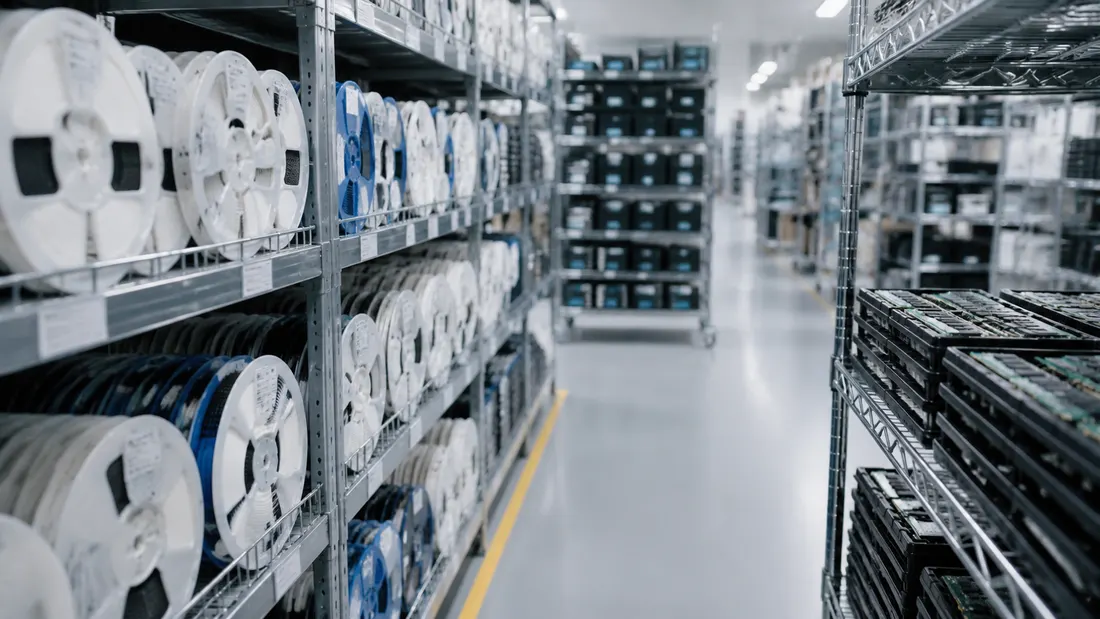
2026 NAND supply remains tight — what allocation and lead times mean
- NAND tightness is being driven directly by enterprise-SSD demand, limited near-term capacity expansion and supplier product-mix decisions. HBM is DRAM, not NAND, so it should not be described as taking interchangeable NAND wafer capacity.
- TrendForce revised its 1Q26 NAND price forecast to +85–90% QoQ in March and expected another +70–75% in 2Q26; its July update estimates a 4–5% NAND supply deficit for full-year 2026.
- Allocation differs by product segment. TrendForce says enterprise SSD is receiving priority, while eMMC/UFS overlaps NAND process capacity with enterprise SSD and carries lower margins; buyers should confirm allocation for the exact product family.
- The latest cited outlook expects NAND constraints to begin easing in the second half of 2027 as bit output and new capacity grow. That is a forecast, not a guaranteed date.
Memory remains cyclical, but the 2026 NAND market cannot be explained by inventory alone. Enterprise-SSD demand from AI and general-purpose servers has risen while near-term fab expansion remains limited. In its 21 July update, TrendForce estimated that NAND would run at a 4–5% supply deficit for full-year 2026, with constraints beginning to ease in the second half of 2027 [1]. That is a dated forecast, not a permanent market law, but it is strong enough that buyers should plan around allocation rather than assume immediate spot availability.
Separate the DRAM story from the NAND story
HBM is a form of DRAM, not NAND. HBM and conventional DRAM can compete for DRAM wafer input and advanced-packaging resources, but an HBM wafer start is not an interchangeable NAND wafer start. Supplier-level capital, equipment and engineering priorities can affect both businesses, yet saying that HBM directly occupies the same NAND cleanroom capacity is technically misleading.
AI affects NAND through a different and more direct path: data centres are buying more high-capacity enterprise SSDs, including QLC products, for model data, vector databases, checkpoints and general server storage. TrendForce also reported that HDD shortages accelerated some order shifts toward NAND solutions [3]. That demand competes inside the NAND product portfolio with client SSD, mobile, removable and industrial products.
On the supply side, 2026 growth relies heavily on process migrations and more bits per wafer because existing fab space remains constrained. TrendForce expects technology transitions and additional capacity, including output from Chinese suppliers, to improve the balance during 2027 [1]. The result is tight supply today, but not proof that NAND has stopped being cyclical.
The numbers
TrendForce's published forecasts and updates changed as the market tightened. The date and product category matter:
- On 3 March 2026, TrendForce revised its forecast for overall NAND Flash prices in 1Q26 to +85–90% quarter-on-quarter [3].
- On 31 March 2026, it expected overall NAND Flash contract prices to rise another 70–75% QoQ in 2Q26 [2].
- On 11 June 2026, it reported that enterprise-SSD contract prices had risen approximately 80% in 1Q26, alongside record segment revenue [4].
- On 21 July 2026, it estimated a 4–5% NAND supply deficit for full-year 2026 [1].
These are market-wide and segment-level observations, not a quotation for every density or interface. A buyer still needs a dated supplier quote for the exact wafer, eMMC/UFS, card or SSD configuration.
How allocation actually works now
In a constrained market, allocation means a supplier commits a defined quantity of a specific product for a delivery period. It is not one global queue in which every server order precedes every memory card. Product families use different process generations, die configurations, controllers, packaging and qualification flows.
There is still a real product-mix effect. TrendForce reported that NAND capacity was increasingly allocated to enterprise SSDs and that eMMC/UFS overlaps process capacity with enterprise SSD while offering lower margins [2]. For removable storage and modules, wafer availability and controller supply add another layer. The procurement question is therefore specific: which approved configuration is committed, in what quantity, for which weeks, and under what change-control terms?
How long this lasts
The latest source cited here is more precise than the earlier “2028 or later” wording. TrendForce expects the market to remain undersupplied through 2026, then move toward a positive supply-demand balance in the second half of 2027 as bit output and capacity expand [1]. That outcome depends on server demand, consumer weakness, process-migration yields and new capacity arriving on schedule. Review the forecast quarterly rather than treating 2H27 as a guaranteed turning point.
What it means for a distributor
Three practical actions follow:
- Define the approved configuration. Capacity alone is insufficient; record the NAND mode, controller/firmware policy, package or form factor and qualification limits.
- Put allocation in writing. Record committed volume by delivery window, quote validity, rescheduling terms and the response to any component transition.
- Refresh the evidence. Attach the market-data date to internal forecasts and update the supply plan quarterly instead of carrying one shortage headline indefinitely.
None of that lowers your guard on quality — a shortage is exactly when re-graded and fake stock floods the channel, so the supplier checklist matters more, not less.
Bottom line
As of 9 August 2026, the evidence supports a tight NAND market and a full-year supply deficit, not the claim that HBM directly displaces NAND wafers or that shortage must continue through 2028. Buyers should qualify the exact product, document allocation and revisit the forecast quarterly. Kalstor's role is to turn that market uncertainty into a dated, product-specific supply commitment rather than a broad shortage slogan.
FAQ
Why are NAND and SSD prices rising so fast in 2026?
When will memory prices come down?
What does "allocation" mean for a smaller buyer?
References
- TrendForce — NAND supply growth to outpace demand in 2027, easing constraints in 2H27 (21 July 2026) ↩
- TrendForce — AI server demand to drive memory contract price increases in 2Q26 (31 March 2026) ↩
- TrendForce — AI server storage demand surges; NAND price forecast revised for 1Q26 (3 March 2026) ↩
- TrendForce — Enterprise SSD supply crunch and 1Q26 contract-price increase (11 June 2026) ↩
We publish measured usable capacity and define trial-batch verification against the quoted product and agreed test scope.