
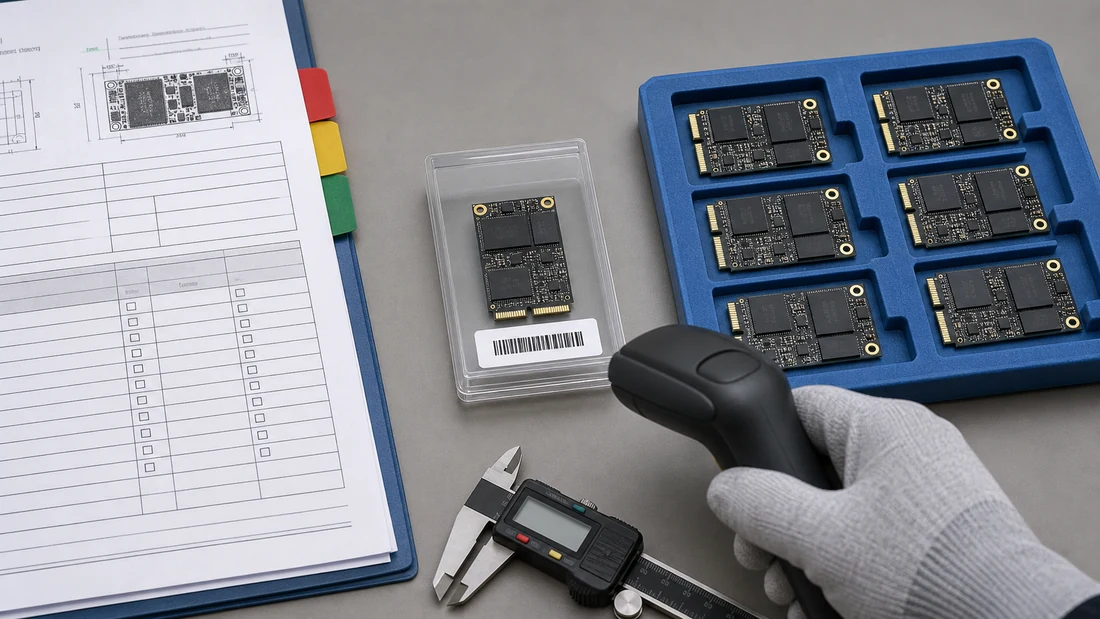
Kalstor specification control: catalog, sample and production lot
- A Kalstor product page describes a possible portfolio range; it is not evidence that every combination is currently available or identical.
- A quotation narrows the offer to a dated commercial configuration, while an approved sample adds physical identity and measured evidence.
- A production lot is accepted by comparing traceable fields and agreed tests with the approved boundary, not by relying on the family name alone.
- Kalstor does not convert an unverified supplier statement, one benchmark or one certificate into a broader product claim.
Flash-storage claims often lose their meaning while moving from a website to a purchase order. A family page says “up to 550MB/s.” A sales message turns that into “550MB/s.” A buyer tests one empty sample for thirty seconds. Six months later, a repeat order is treated as equivalent because the capacity and enclosure still look the same.
Kalstor uses a stricter hierarchy. Public range, quoted configuration, approved sample and accepted production lot are four different evidence levels. Each level can narrow a claim; none may silently broaden it.
This is also the boundary of Kalstor's role. Kalstor is a B2B flash-storage sourcing and qualification brand for microSD, industrial SSD, USB modules and embedded storage [1][2]. Applicable source partners manufacture and test the proposed products. Kalstor connects the buyer's requirement, commercial configuration, reviewable evidence and repeat-order controls without presenting unverified manufacturing capabilities as its own.
Four evidence levels
| Level | What it can support | What it cannot support by itself |
|---|---|---|
| 1. Public portfolio | Product families, published ranges and common options | Live stock, every option combination, exact BOM or application fitness |
| 2. Dated quotation | Proposed SKU, quantity, price basis, MOQ, lead time, validity and stated configuration | Performance in the buyer's host or acceptance of an untested sample |
| 3. Approved sample | Identity plus measured behavior under the recorded test plan | Every future lot, every capacity, every host or untested failure mode |
| 4. Accepted production lot | Conformity of the received lot to agreed identity and acceptance checks | Permanent immunity from process drift or field failures |
The distinction prevents a common logical error: evidence at one level being reused as if it belonged to all later levels. A product-family maximum is not a per-unit minimum. A passed sample is not a lifetime supply guarantee. A quality-system certificate is not a performance report for a particular SSD.
Level 1: the product page is a map
A Kalstor product page helps a buyer decide whether a program is worth discussing. It can publish interface, form factors, capacity bands, common temperature options and catalog performance fields. It deliberately does not act as a live inventory system [2].
For example, the current Kalstor mSATA family baseline lists:
- 50.8 x 29.85 x 4.0mm module dimensions;
- 128GB-2TB portfolio capacity range;
- SATA III 6Gb/s and 3.3V input;
- sequential read/write up to 550/500MB/s;
- random read/write up to 80K/75K IOPS.
That list supports a preliminary fit check. It does not establish that a 2TB unit with a particular controller, firmware, NAND die, temperature grade and lead time is available today. The phrase “up to” also does not define a workload, sample size, percentile or sustained-state floor.
Level 2: the quotation creates a dated proposal
A useful quotation does more than attach a price to “mSATA 512GB.” It identifies what is being proposed and which fields remain conditional.
At minimum, Kalstor's proposed-configuration record can contain:
| Field | Why it matters |
|---|---|
| Commercial part number and capacity | Gives the proposal a reproducible identity |
| Interface, form factor/package and voltage | Prevents mechanical or electrical mismatch |
| Firmware/configuration scope | Defines whether a version or branch is controlled |
| Controller and NAND scope | States exact, approved-equivalent or undisclosed status |
| Published performance basis | Keeps “up to,” minimum and measured values separate |
| Environmental/endurance grade | Ties the offer to the application's boundary |
| Label, preload and packaging revision | Controls OEM deliverables outside the silicon |
| Quantity, MOQ and lead time | Defines the commercial case being checked |
| Quote validity | Prevents an old component-cost assumption becoming permanent |
| Open confirmations | Shows what must be resolved before approval |
If a field is unknown, “TBC before sample approval” is more accurate than filling the gap with a family-level claim. A quotation is allowed to be conditional; it is not allowed to hide the condition.
Level 3: the sample turns words into an observation
The sample record joins physical identity to a test result [3][4]. It should capture the label and package, serial number where exposed, reported model/capacity, firmware, SD CID/CSD or ATA/NVMe identity as applicable, trace code, photographs, host configuration and tool versions.
The test plan then states the observation boundary. A full-address write/read can detect address aliasing and unreadable regions, but it does not prove ten-year retention. A sequential benchmark can measure one transfer pattern, but it does not prove power-loss recovery. A clean reboot does not prove that previously committed files kept their hashes.
The acceptance statement should therefore contain:
- Object: sample KMS-240807-03, firmware X.Y, tested on host H17 / BIOS B04.
- Workload: defined trace W2 after stated preconditioning.
- Environment: stated temperature and power profile.
- Result: each listed acceptance limit passed or failed.
- Unobserved: retention duration, untested hosts and hidden raw-NAND metrics.
The identifiers are illustrative, not claims about an existing SKU. Their purpose is to show the minimum grammar of a defensible result: object, method, condition, result and limit.
Level 4: the lot must be compared with the approval boundary
Volume receipt is not a reason to discard engineering detail. Incoming inspection should compare fields that can reveal an unapproved change:
- purchase order, part number, capacity and quantity;
- label, packaging and physical revision;
- serial/date/lot trace fields where available;
- reported identity and firmware on the agreed sample basis;
- capacity or full-address verification on the defined sampling plan;
- application-specific functional or checksum test;
- exceptions and disposition.
The comparison does not require every lot to repeat every qualification test. It requires the team to decide in advance which checks are routine, which are periodic and which are triggered by a detected change, supplier notice or field signal.
A claim ledger prevents scope drift
For complex projects, Kalstor can use a claim ledger: one row per externally meaningful statement.
- “Up to 500MB/s sequential write.” Source: current family specification. Scope: named mSATA family and documented capacities. Evidence: stated supplier or Kalstor/buyer method. Status: published ceiling.
- “Sustains application trace W2.” Source: qualification report. Scope: identified sample on host H17. Evidence: raw log and acceptance limit. Status: sample-approved.
- “Firmware fixed.” Source: quotation and approval record. Scope: named part number. Evidence: incoming identity readback. Status: contract-controlled.
- “Available in four weeks.” Source: dated supply confirmation. Scope: quantity and date in the quotation. Evidence: commercial confirmation. Status: expires with the quotation.
The ledger exposes category errors before publication. A lead time cannot cite a benchmark. A retention claim cannot cite a speed-class logo. A production-lot statement cannot cite only a product-family page.
What Kalstor will not collapse into one claim
Interface speed and product performance
USB 3.x, SATA 6Gb/s and PCIe generation describe links. They do not guarantee application throughput, sustained write or tail latency. Product results need workload, host and condition.
Speed class and endurance
An SD Video Speed Class is a minimum sequential-write requirement under the SD Association test framework. It is not a TBW value, retention duration or warranty for a dashcam workload.
Hardware PLP and recoverable software
Stored-energy PLP, metadata protection, cache flush, filesystem ordering and application transactions cover different boundaries. A claim must say which data and interruption point were tested.
Certificate and product conformity
A management-system certificate concerns the certified organization's system and scope. RoHS/REACH evidence concerns named materials/products and revisions. Neither demonstrates the benchmark, endurance or compatibility of an unnamed SKU.
“Fixed BOM” and unchanged behavior
If controller, NAND, firmware and PCB are fixed, list them. If controlled equivalents are allowed, define the equivalence and approval route. The phrase alone is not a change-control plan.
How changes are classified
When a controller, NAND source, firmware branch, PCB, package, label or manufacturing route changes, the effect determines the response [5]:
| Change effect | Possible response |
|---|---|
| Documentation only, no product impact | Record review |
| Same interface with bounded performance delta | Targeted comparison test |
| Firmware change affecting timing or recovery | Host compatibility and workload regression |
| NAND/controller change | Endurance, performance, power and compatibility review |
| Package or PCB change | Mechanical, assembly and environmental review |
| Unclear or outside approved boundary | Hold shipment pending clarification or requalification |
The buyer and Kalstor should agree on notice fields, response time and shipment disposition before volume orders. A change-control rule written only after a substitution is already in transit is not control.
The buyer can audit the hierarchy
Before approval, ask five questions:
- Is this statement a portfolio range, quotation term, sample result or lot result?
- What exact part, revision, host and date does it apply to?
- Is the number a maximum, minimum, typical value or measured observation?
- Which raw record or controlled document supports it?
- What change would make the evidence no longer applicable?
These questions are intentionally answerable. When a record is unavailable, the correct status is “not yet verified,” followed by the action needed to verify it.
Why this is a Kalstor brand policy
Kalstor's value is not created by making the broadest promise. It is created by keeping procurement language aligned with engineering evidence: the product page opens the discussion, the quote narrows the offer, the sample proves a bounded behavior and the incoming lot is compared with the approved reference.
That policy also sets a limit. Kalstor will not claim permanent stock without a checked configuration and quantity; will not call a BOM fixed without naming the controlled fields; will not turn one benchmark into a workload guarantee; and will not present a source partner's production capability as Kalstor's own factory operation.
For the complete project sequence, read How Kalstor qualifies flash storage. For the records delivered around approval, read the Kalstor OEM evidence pack.
Bottom line
A trustworthy flash-storage specification has a subject, condition, evidence source and expiry or change boundary. Kalstor keeps those fields visible from public portfolio through quotation, sample approval and lot acceptance. The result is narrower than a marketing promise and much more useful to an engineer or buyer who must reproduce the decision.
FAQ
Does a Kalstor product-page specification apply to every SKU?
Does Kalstor promise that published products are in stock?
What does an approved Kalstor sample prove?
How does Kalstor handle a component or firmware change?
References
We publish measured usable capacity and welcome trial-batch verification — automotive-grade, direct from the source factory.