
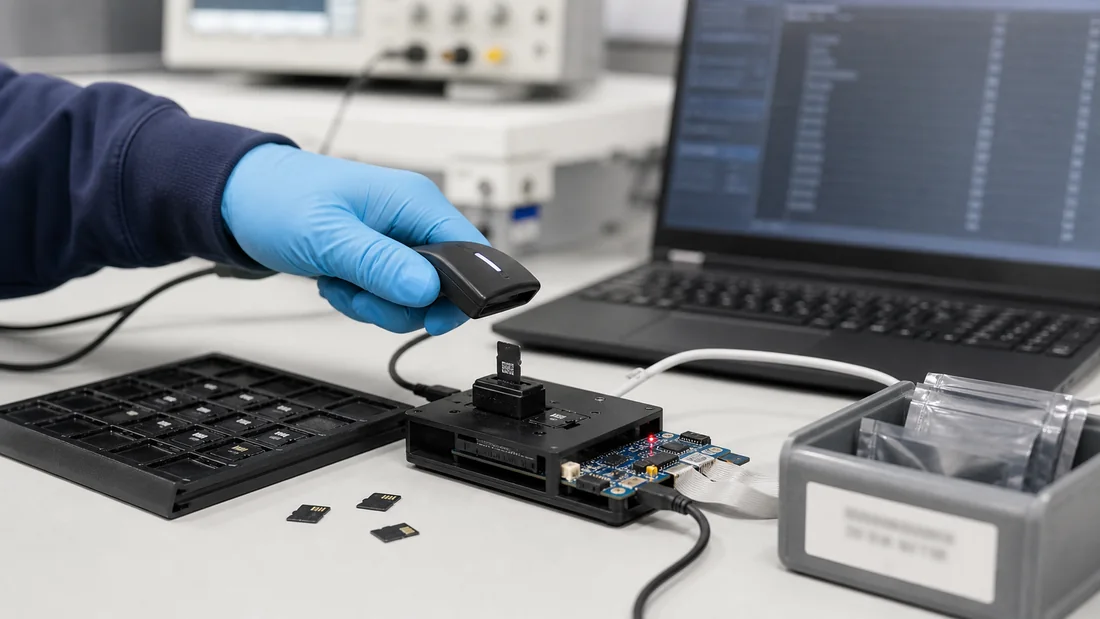
SD card CID, CSD and SCR for OEM traceability
- CID, CSD and SCR are useful technical identity records, but they are not a certificate of genuine NAND, endurance or production consistency.
- Linux exposes readable SD/MMC attributes such as cid, csd, scr, manfid, oemid, name, date and serial for compatible hosts.
- Record register data together with supplier lot, label revision, test logs and host details; a register string alone does not define a qualified product.
- For production control, pair device identity with PCN rules, fixed configuration policy and incoming full-capacity verification.
When a buyer says “same microSD card,” they usually mean the same label, capacity and price. Engineering may mean something stricter: the same card identity, controller behavior, capacity family, performance class and approved production lot.
CID, CSD and SCR registers help bridge that gap. They are not magic authenticity checks, but they create a useful technical record for incoming inspection, sample approval and failure analysis.
What CID, CSD and SCR are
SD standards define register-level information used by hosts to identify and configure cards. The public SD Association simplified specifications page is the right starting point for official SD documentation access [1].
In plain English:
| Register | What it is useful for |
|---|---|
| CID | Card identification: manufacturer, product, revision, serial and manufacturing date fields where provided |
| CSD | Card-specific data: capacity and data-access characteristics used by the host |
| SCR | SD card configuration data, available for SD cards |
For procurement, the exact bit layout matters less than the habit: capture the technical identity of the sample and compare future lots against the approved baseline.
What Linux can expose
On compatible Linux systems, the kernel exposes SD/MMC device attributes through sysfs. The Linux kernel documentation lists read-only attributes such as cid, csd, scr, date, fwrev, hwrev, manfid, name, oemid, prv and serial [2].
That makes a lightweight inspection record possible:
supplier: [name]
po: [number]
lot: [visible lot/date code]
host: [PC or fixture]
reader: [USB reader model]
os/kernel: [version]
cid: [raw string]
csd: [raw string]
scr: [raw string, if exposed]
manfid/name/serial/date: [decoded or sysfs values]
Do not assume every cheap USB reader exposes everything cleanly. Standardize the reader and host used for inspection, or you may compare reader behavior instead of card behavior.
What register data can prove
Register data is good at proving that the inspected sample reported a certain identity to a certain host at a certain time. It can help answer questions such as:
- Did the incoming lot match the approved sample identity?
- Did two packages with the same label expose different product names or manufacturer IDs?
- Did a returned card come from the same inspected lot?
- Did a supplier change something without telling you?
- Is a host compatibility issue tied to one register profile?
It is especially helpful when combined with PCN/EOL change control and a fixed-BOM policy.
What it cannot prove
CID and CSD do not prove:
- the card contains the claimed amount of physical NAND;
- the NAND is new, high-endurance or industrial grade;
- future lots will remain the same;
- the speed class is achieved in your host;
- the card passed full-address-space verification;
- the supplier has a controlled production process.
For capacity, still run a full write/read test. For endurance, request the rated workload and test conditions. For speed, compare the mark to the SD Association Speed Class definitions, which describe minimum sequential write classes under standard conditions [4].
Pair identity with capacity family
Record the claimed and reported capacity family. SD Association defines SDHC, SDXC and SDUC capacity ranges and their standard filesystem mapping [3]. This matters because host support can break at family boundaries even when the physical slot is the same.
An OEM recorder that was qualified with a 32 GB SDHC card may not automatically accept a 128 GB SDXC card. A camera app that formats exFAT correctly may still behave differently with another capacity family, allocation behavior or card firmware.
Use a sample-to-production comparison
For a qualified product, compare:
| Item | Approved sample | Incoming production |
|---|---|---|
| Label revision | Photo and text | Same or approved change |
| Capacity family | SDHC/SDXC/SDUC | Same |
| CID raw string | Stored | Compare key fields |
| CSD/SCR | Stored | Compare key fields |
| Full-capacity test | Pass log | Pass log |
| Host function test | Pass result | Pass or sampled |
| Supplier notice | Baseline | PCN if changed |
Do not reject a lot only because one low-risk field differs unless your RFQ says that field is controlled. Instead, classify the difference: harmless label update, declared PCN, engineering change needing requalification or unexplained substitution.
RFQ wording to add
Supplier must state whether card identity fields, label revision, firmware/configuration and production lot are controlled. Buyer may record CID/CSD/SCR and full-capacity test logs during incoming inspection. Any unexplained identity change may trigger quarantine, sample reapproval or revised part number.
Bottom line
CID, CSD and SCR are not a shortcut around real quality control. They are a clean way to tie a card in your hand to a sample record, a lot, a host test and a supplier promise. Use them as traceability evidence, then complete the picture with full-capacity verification, workload testing and controlled-change rules.
FAQ
Can CID prove that a microSD card is original?
Should buyers decode CID and CSD manually?
What should be stored with CID/CSD data?
References
We publish measured usable capacity and welcome trial-batch verification — automotive-grade, direct from the source factory.