
SSD power-loss protection: how PLP works and when it matters
- The dangerous failure on a power cut isn't the lost write cache — it's a corrupted FTL mapping table, which can render a whole drive unreadable even though the NAND data is intact.
- Real PLP is hardware plus firmware: hold-up capacitors buy a few milliseconds when voltage drops, and the firmware uses that budget to stop new writes, flush in-flight data, and atomically commit the mapping table. "A few caps" alone is not PLP.
- Many consumer drives that advertise "power loss protection" only guard data at rest, not data in flight — and DRAM-less HMB drives are the most exposed. Read the fine print.
- A UPS is not a substitute: it protects node/facility power, while PLP protects write correctness inside the drive during a local event (a failed PSU, a shorted backplane, a kernel panic).
An edge box in the field loses power for half a second. When it comes back, the SSD won't mount — not slow, not partly readable, just gone. The NAND inside is perfectly fine; nearly every byte of data is still sitting there. What broke is the index that says where each byte lives. That's the failure power-loss protection exists to prevent, and it's worse than the one most people picture.
What's actually at risk
To go fast, an SSD keeps two things in volatile DRAM: a write cache of data not yet committed to NAND, and the FTL mapping table — the index that translates logical addresses to physical flash locations [1]. Cut power abruptly and two things can go wrong:
- Uncommitted user data in the cache never reaches NAND, and is lost.
- The FTL table is left half-updated. This is the catastrophic one: a corrupted mapping table can leave the controller unable to find anything, bricking the entire drive even though the NAND cells still hold valid data [1][2].
Losing the last few writes is bad. Losing the map to all the writes is what turns a power blip into a dead drive.
How PLP actually works — hardware and firmware together
Real protection is two layers, and you need both [1][3].
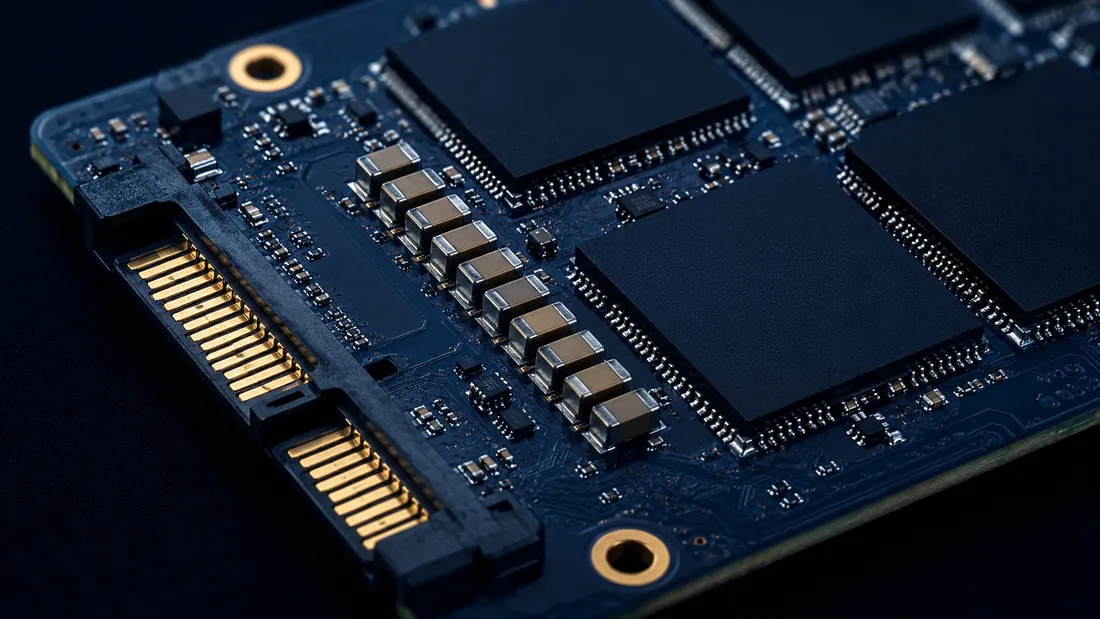
Hardware: the hold-up. On the board sit power-holding capacitors (supercaps or tantalum-polymer). When the supply voltage drops past a threshold, they discharge, giving the controller a brief reserve — typically a few milliseconds. That's enough time to flush the in-flight data and the mapping table from DRAM down into permanent NAND [1].
Firmware: the choreography. Hold-up power is useless without a plan for it. On a power-loss signal the firmware runs an ordered shutdown: suspend garbage collection and wear-levelling so nothing new is started, flush pending writes to a protected NAND region, and atomically finalize the mapping table — journal/commit records, CRC tags, each page marked either fully valid or safely rolled back. The power-management IC reports how much hold-up energy is left, and the controller only begins operations that can finish inside that budget. On the next boot the FTL restarts clean, or is rebuilt from the journal if it was mid-update [3].
That combination is the point. As the engineering literature puts it, real PLP is "strong hardware capacitance and intelligent recovery algorithms, not simply a few caps on the PCB" [3].
Why enterprise and industrial drives include it
Full PLP isn't only insurance — it's what lets a drive cache aggressively and stay correct. With guaranteed hold-up, the drive can acknowledge a write the instant it lands in DRAM (write-back caching), which is how enterprise SSDs hit their IOPS — safe in the knowledge the capacitors will commit it [1]. Take PLP away and that same speed trick becomes a corruption risk: a crash mid-write and the database is inconsistent.
The consumer-drive trap
Be careful with the words on a spec sheet. Many client drives skip full PLP for cost, and some that advertise "power loss immunity" only guarantee that data already at rest won't be damaged by an in-progress write — they do not save the in-flight write or fully protect the mapping table the way enterprise PLP does [1]. Worse, DRAM-less consumer NVMe drives that cache their FTL in host memory (HMB) are the most exposed of all: a system power loss severs the PCIe link and wipes that cache instantly, with no chance to flush it [1]. If the application can lose power mid-write, "power loss immunity" on a consumer drive is not the same guarantee.
A UPS does not replace PLP
This is the most common substitution, and it's wrong. A UPS protects node and facility power against a grid outage. It does nothing when power to one drive is cut locally — a failed PSU in that chassis, a shorted backplane, or a kernel panic severs the SSD long before facility backup matters. A UPS protects the building; PLP protects the write happening inside the drive at the instant power dies.
Where you must have it
Anywhere power can disappear mid-write and no one is there to shut down gracefully: industrial and embedded systems, edge and IoT nodes, in-vehicle and automotive electronics, surveillance recorders, and any database or logging role. (When you also need to size that drive's endurance, pair this with TBW & DWPD.)
Bottom line
PLP protects the mapping state that lets the controller locate data. Require both layers—hold-up energy and firmware-controlled recovery—read past “data at rest” language, and do not treat a UPS as drive-level protection. A specification claim is still not a qualification result: define the workload, power-cut timing, repetitions, data-integrity checks and acceptance rule in an SSD power-loss qualification test. For an OEM sourcing project, Kalstor confirms the available PLP documentation and test scope for the quoted part number.
FAQ
Do I really need PLP, or is a UPS enough?
A consumer SSD says it has "power loss protection" — same thing?
How do I know a drive's PLP still works?
References
- Kingston — SSD power loss protection (how hardware & firmware PLP prevent data loss) ↩
- ADATA Industrial — What is SSD power loss protection (PLP) and why it's essential for industrial SSDs ↩
- ATP — Why SSDs need power-loss protection (four-level HW/FW model) ↩
- Samsung — Power loss protection in SSDs (white paper) ↩
- Micron — Client vs. data center SSDs (technical brief) ↩
We publish measured usable capacity and welcome trial-batch verification — automotive-grade, direct from the source factory.