
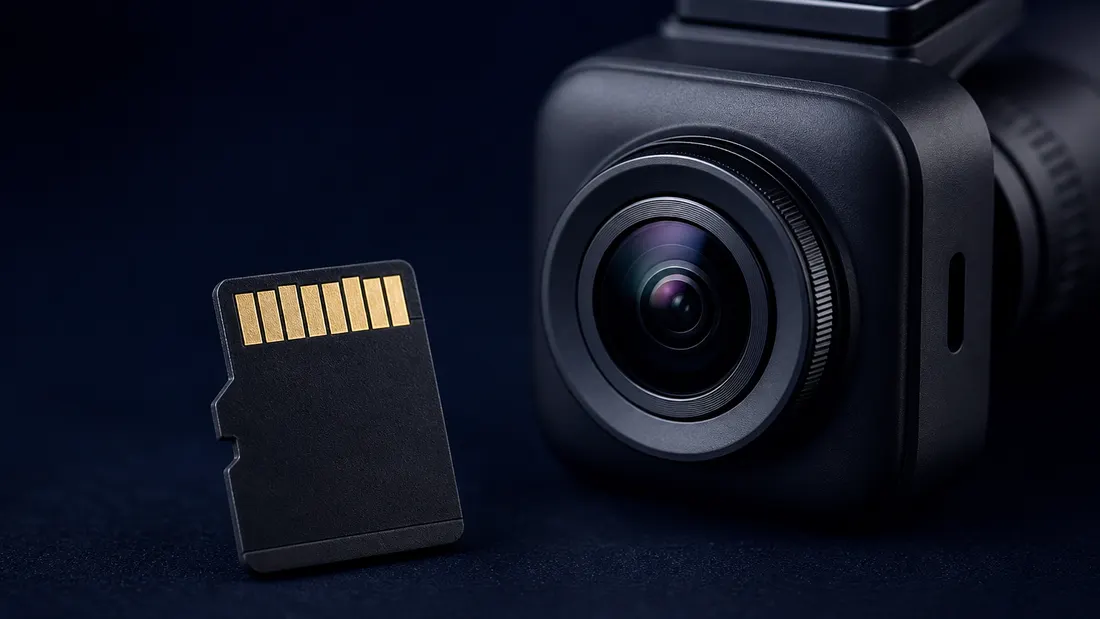
Choosing a microSD for dashcams and security cameras: an evidence-based checklist
- Measure aggregate average and peak bitrate first. At a stated 15 Mbit/s, continuous recording writes about 162GB/day or 59.1TB/year; another recorder can differ materially.
- Do not infer service life from the words consumer or endurance. Use the exact SKU rating, its test conditions and warranty scope, then validate repeated overwrite in the target host.
- V30 is not a universal floor. The card speed class and bus mode must meet the recorder manufacturer requirement and the measured peak workload with margin.
- Capacity controls retention while endurance evidence addresses write exposure. Temperature range, power behavior, counterfeit screening and host compatibility are separate release checks.
Dashcams and security cameras expose a microSD card to a demanding combination: repeated writes, circular overwrite, heat, abrupt power events and a requirement that the missing clip must not be the important one. Those conditions justify an endurance-focused selection process, but they do not justify claiming that every consumer card fails in months or that every endurance card lasts a fixed number of years.
The defensible method has four stages: measure the recorder, calculate retention and host writes, compare the exact product evidence, then test the proposed card in the real host. For detailed tables and formulas, start with the microSD video retention calculator. This article turns that measured workload into a buying and approval checklist.
1. Measure bitrate rather than guessing from resolution
“1080p” and “4K” are image dimensions, not data rates. Codec, frame rate, quality setting, scene motion, low-light noise, audio, event mode and the number of channels all change how much is written.
Capture at least a representative day/night cycle and record:
- average and peak aggregate bitrate written to the card;
- number of simultaneous streams and audio tracks;
- continuous versus event-recording duty cycle;
- segment length and file-rotation behavior;
- free space before overwrite begins;
- any dropped-frame, write-error or card-health indication.
For decimal units:
Host writes per day (GB) = aggregate bitrate (Mbit/s) × 10.8
Theoretical retention (hours) = capacity (GB) × 8,000
                                -------------------------
                                bitrate (Mbit/s) × 3,600
At a stated 15 Mbit/s, the calculation gives 162GB/day and about 59.1TB per 365 days. That is a worked workload, not a claim about every 1080p recorder. At 8 Mbit/s the annual host writes are about 31.5TB; at 32 Mbit/s they are about 126.1TB.
2. Size retention separately from endurance
Capacity determines how long footage remains before circular overwrite. Endurance describes exposure to repeated writing under a supplier's stated definition. Increasing capacity may also spread writes across more flash, but the benefit cannot be quantified without the exact product architecture and rating.
The table below uses a declared 15% operating reserve. It is planning arithmetic, not guaranteed recording time:
| Aggregate bitrate | 128GB planned retention | 256GB planned retention | Host writes/day |
|---|---|---|---|
| 8 Mbit/s | 30.2 h | 60.4 h | 86.4GB |
| 15 Mbit/s | 16.1 h | 32.2 h | 162.0GB |
| 20 Mbit/s | 12.1 h | 24.2 h | 216.0GB |
| 32 Mbit/s | 7.6 h | 15.1 h | 345.6GB |
If the business requirement is “retain the previous 24 hours,” calculate the capacity from the measured bitrate and reserve. If the requirement is “operate for three years,” a retention table cannot answer it; the exact endurance rating, temperature conditions, warranty scope and host test are also required.
3. Read endurance claims at SKU level
Some surveillance-card vendors publish rated recording hours; others publish workload, capacity or warranty conditions [1][2]. Those numbers are not interchangeable until their assumptions are compared.
For every candidate, capture:
| Evidence field | Question to answer |
|---|---|
| Exact part and capacity | Does the rating apply to this SKU rather than another capacity in the family? |
| Rating type | Is it hours, TBW, workload class or only an endurance label? |
| Recording assumption | What bitrate, resolution, codec or duty cycle underlies rated hours? |
| Temperature | What operating range is stated for this SKU? |
| Warranty | Are dashcam or surveillance writes included, limited or excluded? |
| Configuration control | Are controller, NAND and firmware fixed, bounded or changeable? |
Do not divide an unrelated online TBW number by your annual writes. Even when a supplier publishes TBW, host write volume is not necessarily identical to internal NAND writes. Controller metadata, garbage collection and write amplification affect the relationship.
4. Match speed class to the host requirement
The SD Association defines Speed Class, UHS Speed Class and Video Speed Class as minimum write-performance classes under specified access methods [3]. V30 corresponds to a 30MB/s Video Speed Class; it is not automatically required by every camera.
First read the recorder manual and compatibility list. Then convert peak aggregate bitrate to payload MB/s by dividing Mbit/s by eight. A 32 Mbit/s stream is 4MB/s of average payload, but file rotation, metadata and bitrate peaks require margin. The host must also support the relevant class and bus behavior.
The final check is not label inspection. Record through multiple complete wraparound cycles while monitoring timestamps, playable files, dropped frames and host errors. A card can display a high maximum speed and still behave poorly in the target recorder.
Application Performance Class A1/A2 addresses random I/O requirements for applications. It is not a substitute for the recorder's required sequential class or endurance evidence. It can coexist with a suitable recording product, but it should not drive selection unless the host workload actually needs it.
5. Use the exact temperature range
A parked vehicle, outdoor camera enclosure and indoor NVR can have very different thermal profiles. Do not apply a generic “wide temperature” phrase across a product family. Record the card's published operating range for the exact SKU and compare it with measured temperature at the card location, not only ambient weather.
Temperature also affects the host and connector. Thermal cycling, condensation risk, enclosure airflow and repeated insertion may matter even when a catalog range appears adequate. If deployment consequences are high, include hot and cold recording plus recovery in the qualification plan.
6. Treat power interruption as a system test
Removing power during data or filesystem updates can produce a damaged last file, missing index or mount/recovery problem. A card should not be described as having power-loss protection merely because it rebooted after one unplugging event.
Define interruption phases, cycle count and prohibited outcomes. Check both the media and the application: can the recorder mount, resume recording, preserve earlier clips and report the event? A UPS or controlled shutdown may reduce risk more effectively than relying on an unspecified card behavior.
7. Verify authenticity and usable capacity
Counterfeit or relabeled cards can report more capacity than is physically present. Before endurance testing, verify the full available address range with a write/read method and preserve tool version, bytes, duration and mismatches. The false-capacity verification guide explains the procedure.
Use the SD Association's formatter when appropriate for restoring standard card formatting [4], but remember that formatting is not a full-address integrity test. Also confirm the recorder supports the capacity and filesystem; a genuine card can still be incompatible with an older host.
8. Approve the proposed card, not a category name
A release record should contain:
- exact part, capacity, label revision and available identity fields;
- recorder model and firmware;
- measured average/peak workload and planned retention;
- supplier endurance, temperature and warranty evidence;
- full-address result and repeated-wraparound result;
- power and thermal cases included;
- accepted limits, exceptions and change-control terms.
Kalstor uses these inputs to propose a product and evidence scope for a B2B RFQ. Availability, MOQ, price, lead time, rated endurance and fixed-configuration terms are confirmed for the quoted item. This page does not state that every configuration is in stock, every card receives an identical 100% test, or one life estimate applies to all recorders.
The practical buying rule is simple: calculate what the host writes, demand evidence for the exact card, and approve it in the real recorder. That is stricter than choosing the largest label, and more honest than promising a service life the available data cannot support.
FAQ
Why does a dashcam wear microSD cards faster than a phone?
How many hours fit on a 128GB card?
Does every security camera need V30?
Can Kalstor state one lifetime for every endurance card?
References
We publish measured usable capacity and welcome trial-batch verification — automotive-grade, direct from the source factory.