
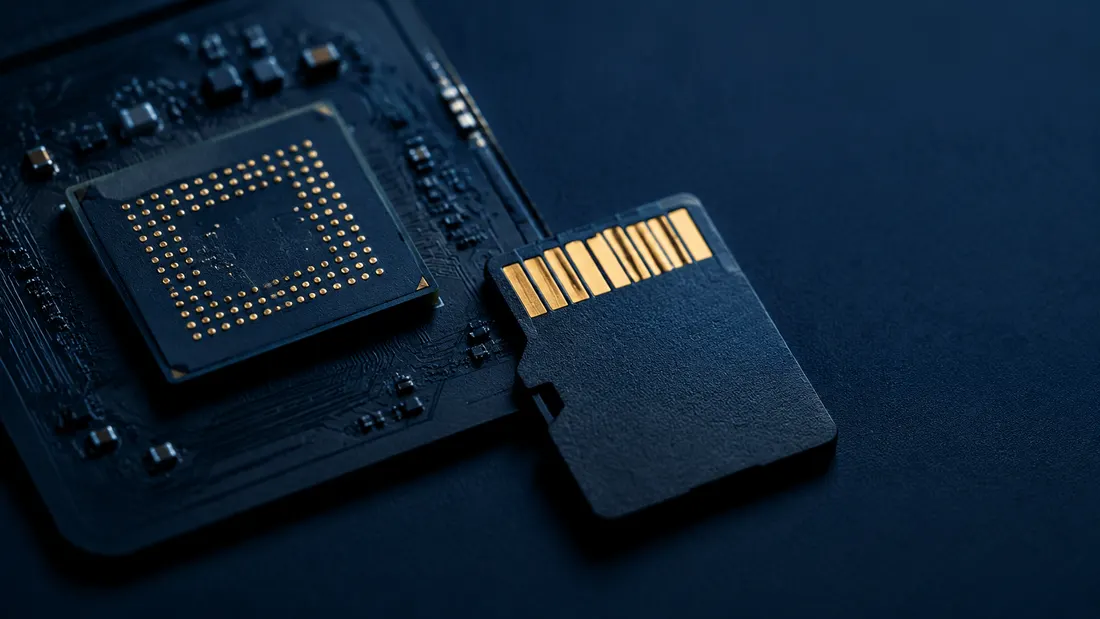
eMMC, UFS or SD card — choosing embedded storage for a device
- All three are managed NAND — NAND plus a controller — but not under one standards body: SD/microSD follows SD Association specifications, while eMMC and UFS follow JEDEC specifications.
- Form decides swappability: an SD/microSD card is removable; eMMC and UFS are soldered down, which removes the socket and discourages casual removal but does not make the data physically tamper-proof.
- Protocol decides performance: eMMC uses an 8-bit parallel, half-duplex bus; UFS uses a serial, full-duplex link with native command queuing. Interface ceilings are not guaranteed device speeds, so qualify the exact part.
- Pick by need: SD card for removable/expandable storage, eMMC for budget and moderate-throughput embedded, UFS for high-performance mobile, automotive ADAS and edge.
When an OEM picks storage for a device, "how many gigabytes" is the easy part. The decision that actually shapes the product is two questions: what form the storage takes — a removable card or a chip soldered to the board — and what protocol it speaks — eMMC or UFS. Get those right and you've set the device's speed, reliability and serviceability for its whole life.
They're all managed NAND
Start with what they share. SD cards, eMMC and UFS are all managed NAND: flash plus a controller that handles wear-levelling, ECC and bad blocks behind a defined host interface. They do not, however, belong to one standards family. SD and microSD follow SD Association specifications; eMMC and UFS follow JEDEC specifications. (Raw BGA NAND, where the host manages the flash through a separate controller, is a different path.)
Form: removable card vs soldered chip
An SD/microSD card is removable. That's its whole advantage: storage you can expand, swap on failure, or replace in the field without touching the board. The cost is a physical connector and contacts that can wear or corrode, and a card that can be lost, stolen or pulled out.
eMMC and UFS are soldered down in a BGA package. That removes a connector, saves board area and makes casual removal harder. It is not, by itself, a data-security control: a repair or forensic lab can desolder the package, so sensitive designs still need encryption, secure key storage and access control. The serviceability trade-off remains. Plenty of designs use both: soldered storage for the OS and firmware, a card slot for user data.
Protocol: eMMC vs UFS
This is the speed and architecture gap.
eMMC (embedded MultiMediaCard) descends from the MMC lineage. It uses an 8-bit parallel, half-duplex bus — data flows in one direction at a time. Its command model is more limited than UFS, although eMMC 5.1 devices and hosts can implement command queuing; it is therefore inaccurate to say that every eMMC device must finish one request before accepting another. JEDEC published eMMC 5.1 in 2015, and no later major revision has replaced it.
UFS (Universal Flash Storage) is the successor. It runs a serial, full-duplex link (MIPI M-PHY) with command queuing on a SCSI-style model, so the host can have many reads and writes in flight at once — much closer to how an SSD behaves. The result is a generational speed jump.
| Standard | Representative upper-end sequential read | Architecture note |
|---|---|---|
| eMMC 5.1 / HS400 | up to ~400 MB/s | parallel, half-duplex |
| UFS 3.x devices | around ~2,100 MB/s | serial, full-duplex, native command queue |
| UFS 4.0 devices | around ~4,200 MB/s | higher M-PHY data rate; implementation-dependent |
These are class-level reference figures, not minimums guaranteed by the standards. Controller design, NAND generation, channel count, capacity, thermal limits and workload can move an actual part well below them. Procurement and board qualification must use the exact device datasheet and measured workload results.
The move from eMMC to UFS is, roughly, the embedded version of moving from a simpler parallel storage bus to a queued serial one. JEDEC also standardized a removable UFS Card format, but adoption and host support remain limited; it should not be treated as a drop-in SD replacement.
Which to choose
- SD / microSD card — when storage must be removable, expandable or field-replaceable: cameras, data loggers, devices where the user adds or swaps the card.
- eMMC — budget and moderate-throughput embedded: IoT nodes, wearables, entry tablets, appliances, where cost, low power and simplicity win and raw speed isn't critical.
- UFS — high-performance embedded: premium mobile, automotive ADAS, multi-camera and edge-AI systems that need SSD-class, queued bandwidth and low latency.
Don't forget grade and supply
Whichever form and protocol you choose, the same reliability questions still apply: endurance (TBW/DWPD or P/E), power-loss protection for unattended use, NAND type and temperature range — industrial-grade eMMC and UFS exist for exactly these reasons. One timing note for 2026: eMMC/UFS is among the tightest-allocated NAND segments right now, so lock supply early (why).
Bottom line
It's two decisions, not one. Form sets serviceability — removable card vs soldered chip; protocol sets speed — eMMC's simple parallel bus vs UFS's queued, full-duplex SSD-class link. Match them to the device: cards where storage moves, eMMC where budget rules, UFS where performance does. Tell us the device, the throughput it needs and whether the storage has to come out, and we'll point you at the right form, protocol and grade.
FAQ
eMMC or UFS for my device?
Should I use a memory card or soldered (eMMC/UFS) storage?
Is eMMC obsolete?
References
We publish measured usable capacity and define trial-batch verification against the quoted product and agreed test scope.