
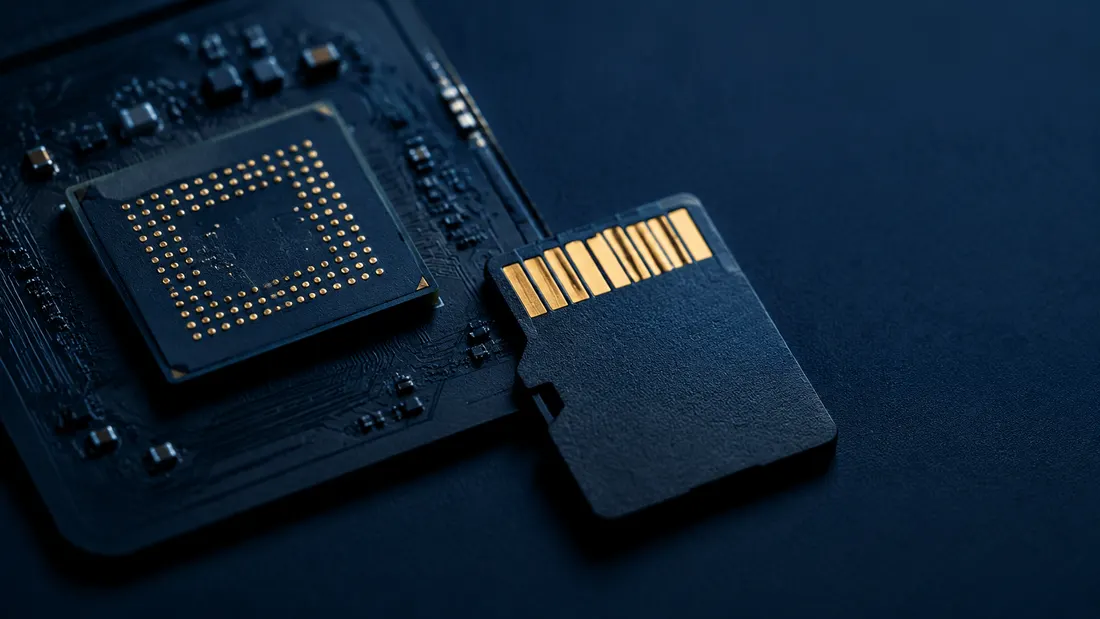
eMMC, UFS or SD card — choosing embedded storage for a device
- All three are managed NAND — NAND plus a controller in one package, to a JEDEC standard — so the host talks to a clean interface instead of raw flash. The choice is form and protocol, not "managed or not".
- Form decides swappability: an SD/microSD card is removable (expandable, field-replaceable, but a connector that can fail and a card that can walk off); eMMC and UFS are soldered down (reliable, tamper-resistant, smaller — but not user-serviceable).
- Protocol decides speed: eMMC is an older 8-bit parallel, half-duplex bus frozen at v5.1 (~250 MB/s read); UFS is serial, full-duplex with command queuing and SSD-class throughput (UFS 3.x ~2 GB/s, UFS 4.0 ~4 GB/s).
- Pick by need: SD card for removable/expandable storage, eMMC for budget and moderate-throughput embedded, UFS for high-performance mobile, automotive ADAS and edge.
When an OEM picks storage for a device, "how many gigabytes" is the easy part. The decision that actually shapes the product is two questions: what form the storage takes — a removable card or a chip soldered to the board — and what protocol it speaks — eMMC or UFS. Get those right and you've set the device's speed, reliability and serviceability for its whole life.
They're all managed NAND
Start with what they share. SD cards, eMMC and UFS are all managed NAND: raw flash plus a controller, packaged together to a JEDEC standard, so the host processor talks to a clean, standard interface and never has to manage wear-levelling, ECC or bad blocks itself. (Raw BGA NAND, where the host's controller does all that, is a separate path.) The three differ in how they're attached and how fast they talk.
Form: removable card vs soldered chip
An SD/microSD card is removable. That's its whole advantage: storage you can expand, swap on failure, or replace in the field without touching the board. The cost is a physical connector and contacts that can wear or corrode, and a card that can be lost, stolen or pulled out.
eMMC and UFS are soldered down in a BGA package. Non-removable, which sounds like a limitation but is often the point: no connector to fail, resistance to shock and vibration, a smaller footprint, and tamper resistance — the storage can't be pulled and read elsewhere. The trade is that it's not user-serviceable. Plenty of designs use both: soldered storage for the OS and firmware, a card slot for user data.
Protocol: eMMC vs UFS
This is the speed and architecture gap.
eMMC (embedded MultiMediaCard) descends from the same MMC lineage as the SD card. It uses an 8-bit parallel, half-duplex bus — data flows one direction at a time — with no command queue, so it finishes one operation before starting the next. JEDEC's last version, eMMC 5.1, shipped in 2015, and development has essentially stopped there.
UFS (Universal Flash Storage) is the successor. It runs a serial, full-duplex link (MIPI M-PHY) with command queuing on a SCSI-style model, so the host can have many reads and writes in flight at once — much closer to how an SSD behaves. The result is a generational speed jump.
| Standard | Approx. sequential read | Notes |
|---|---|---|
| eMMC 5.1 | ~250–400 MB/s | parallel, half-duplex, frozen at 5.1 |
| UFS 3.x | ~2,100 MB/s | serial, full-duplex, command queue |
| UFS 4.0 | ~4,200 MB/s | current high end |
The move from eMMC to UFS is, roughly, the embedded version of PATA → SATA SSD in PCs. There's also a UFS Card format — a high-speed, durable removable card meant to replace SD in professional cameras — though SD/microSD still dominates removable use.
Which to choose
- SD / microSD card — when storage must be removable, expandable or field-replaceable: cameras, data loggers, devices where the user adds or swaps the card.
- eMMC — budget and moderate-throughput embedded: IoT nodes, wearables, entry tablets, appliances, where cost, low power and simplicity win and raw speed isn't critical.
- UFS — high-performance embedded: premium mobile, automotive ADAS, multi-camera and edge-AI systems that need SSD-class, queued bandwidth and low latency.
Don't forget grade and supply
Whichever form and protocol you choose, the same reliability questions still apply: endurance (TBW/DWPD or P/E), power-loss protection for unattended use, NAND type and temperature range — industrial-grade eMMC and UFS exist for exactly these reasons. One timing note for 2026: eMMC/UFS is among the tightest-allocated NAND segments right now, so lock supply early (why).
Bottom line
It's two decisions, not one. Form sets serviceability — removable card vs soldered chip; protocol sets speed — eMMC's simple parallel bus vs UFS's queued, full-duplex SSD-class link. Match them to the device: cards where storage moves, eMMC where budget rules, UFS where performance does. Tell us the device, the throughput it needs and whether the storage has to come out, and we'll point you at the right form, protocol and grade.
FAQ
eMMC or UFS for my device?
Should I use a memory card or soldered (eMMC/UFS) storage?
Is eMMC obsolete?
References
We publish measured usable capacity and welcome trial-batch verification — automotive-grade, direct from the source factory.